My Name is Anonymous, and…
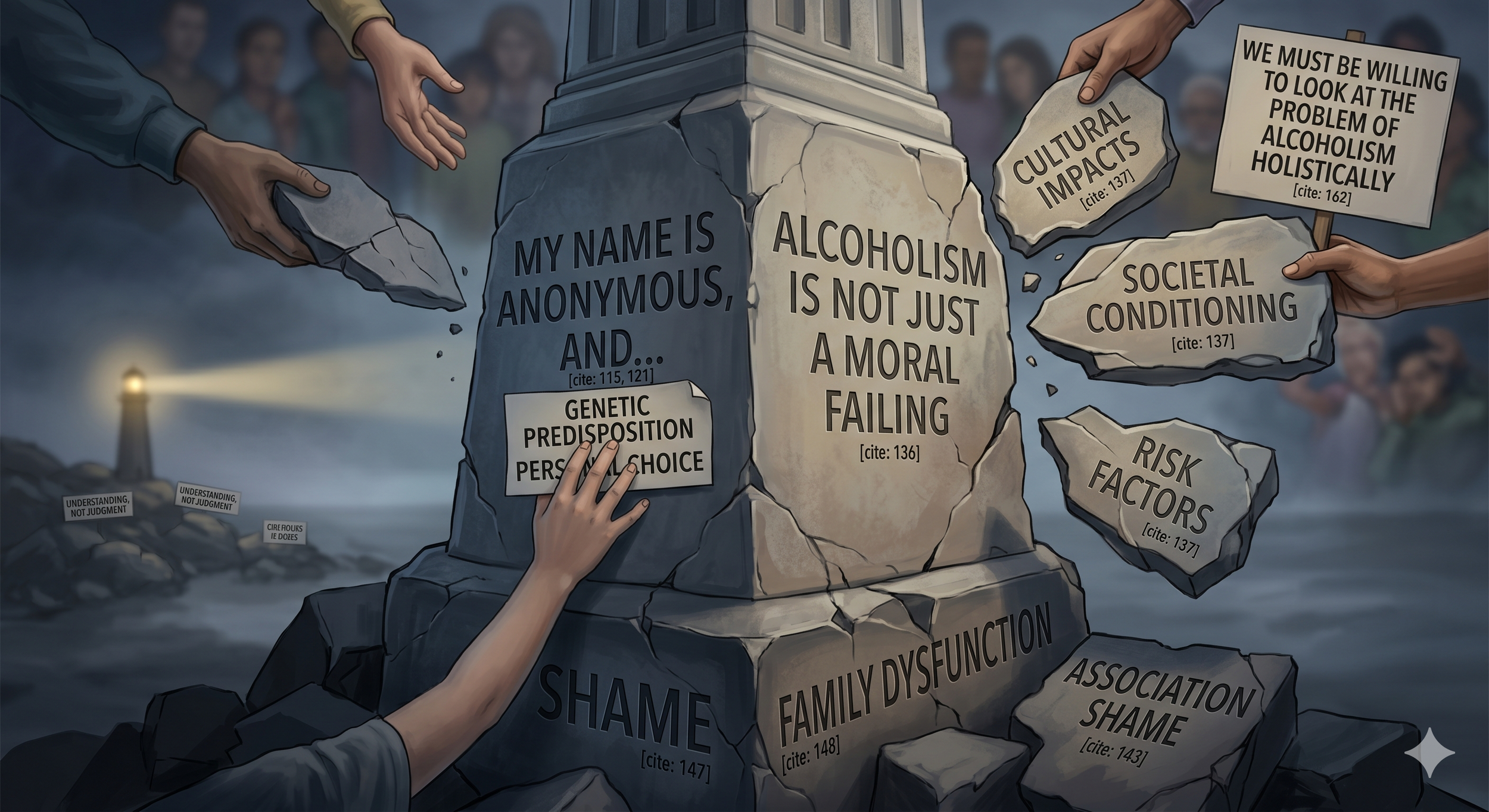
Image generated by Google Gemini using the prompt “Generate an image based on the attached essay.”
We sat in a room with twenty or so strangers, all huddled in our family-group clusters under bad fluorescent lighting that glared off freshly waxed checkered floor tiles. The wax on the floor tiles could be described as lipstick on a pig. Our chairs were the foldout metal ones – dark brown, chipped paint, and uncomfortable. There was a plastic table at the side of the room with paper cups and a big pot of coffee, another of water, and a few cookies that were neither homemade nor delicious; the refreshments were institutional, cheap to make in bulk and offered here out of some social obligation for the cause. This was family night at the hospital where my father was checked in for alcohol rehab, the night that, before you could get your hour of visitation, your visitors had to sit through an Alcoholics Anonymous meeting with you and come to understand the burden you carried. This was not the first time I had attended such in my twelve years of life. It was not the first time that year. Later, on the way home, I would ask my mother why they called it a disease in one breath and in the next said it was up to each alcoholic to want to stop. It’s not a disease if willpower is the cure.
I have been aware of the effects of alcoholism since I was old enough to comprehend life around me. Mine is one of those “it runs in the family” families – my father and several generations back on his side, my uncles, my aunts, they were all self-medicated on alcohol (or worse). From this vantage point I can say: alcoholism is misunderstood and stigmatized inside and out of those most immediately impacted by the disease. For centuries, over-indulgence in alcohol was seen as a personal, moral failing and not a disease capable of intervention and treatment in a medical way. As such, while cures for polio and treatments for diabetes were developed, treatment for alcohol dependency disorder languished and with it the stigma grew. Alcoholism, like all substance-use disorders, is not just a personal, moral failing; it’s a complicated web of genetic predisposition, cultural impacts, societal conditioning and risk factors, all intersecting with personal choice. As the saying goes, “the same water that softens the potato hardens the egg.” Which is to say that while genetics play a role in substance abuse disorders and addiction, there’s more to the mix than just one’s inherited chromosomes. Substance use disorders are an entire band, and personal failings are just the lead singer – the most obviously recognized portion, but not the whole of the show.
The shame surrounding alcohol is also not born by the alcoholic alone. While the alcoholic might be ashamed of their inability to stop or the actions they took – and sometimes do not even remember – during a binge, this is not the only shame surrounding alcoholism. There is the shame of the family and friends who are associated with the alcoholic through the process of association. There is the shame of society that what has driven many alcoholics to drink is a failure to find what they needed outside of the bottle. By socializing men to eschew therapy, by setting the cost of medical treatment for physical or mental ailments out of reach of most of our society, and by looking at everything as an individual problem, we continue to push a portion of our population towards alcohol as a possible solution for their problems. Or, as worded by Harriet M, “The idea is relatively straightforward: when society promotes certain goals, financial success, stability, belonging but systematically blocks access to legitimate means of achieving those goals, people find other ways. Substance use, in this framework, becomes a form of adaptation” (M, 2026). Through this we create a web of shame that reduces the likelihood of someone seeking help or having a successful outcome in fighting their addiction. This plays into the dysfunction of the family and only spreads through socialization to perpetuate the problem.
Nor is recovery a matter of self-forgiveness, problem admission, and being sober for a set period. Among the members of Alcoholics Anonymous, there are those who are called “dry drunks.” These are alcoholics who have been sober for a period (often years) who are still not entirely recovered. They may form addictions to other things, from something as simple as having to go have coffee with friends every day for several hours to the need to fill their time restoring classic automobiles. They may still be incredibly unpleasant people, still dealing with their shame and anger or other pains. These dry drunks have, technically, beaten alcoholism, and yet their ability to function in daily life is just as impaired. Recovering alcoholics are always recovering; each day is a day they must battle for sobriety. We need to understand that there is not a cure, and it takes more than their individual willpower to conquer this battle day after day.
Alcoholism is defined culturally. It is dependent on the circumstances and the perspective of those involved. We judge the amount of alcohol consumed by a college undergrad differently than we do the 50-something businessman. The point where we question how many is too many changes by location; it’s a different amount in the United States than it is in Germany or among party-hardy Kenyans. This means there is no one size fits all solution. Rather, we must be able and willing to look at the problem of alcoholism holistically, defining what we consider negatives collectively, and work on a solution that includes all of us taking responsibility for those around us. As D. B. Heath noted, “sociocultural factors are as critical to the understanding of the influence of alcohol on behavior as psychological considerations” (Humphrey, et al, 2019, p. 132). It’s not the alcoholic’s battle; it’s all of ours.
References
Humphrey, J. A., Schmalleger, F., & Schmalleger, P. F. (2019). Deviant behavior. SAGE Publications.
M, H. (2026, March 1). How society shapes addiction: The hidden sociology of substance abuse. Sociology Inc. https://sociologyinc.com/how-society-shapes-addiction-the-hidden-sociology-of-substance-abuse/