Well, Someone’s Getting Fired
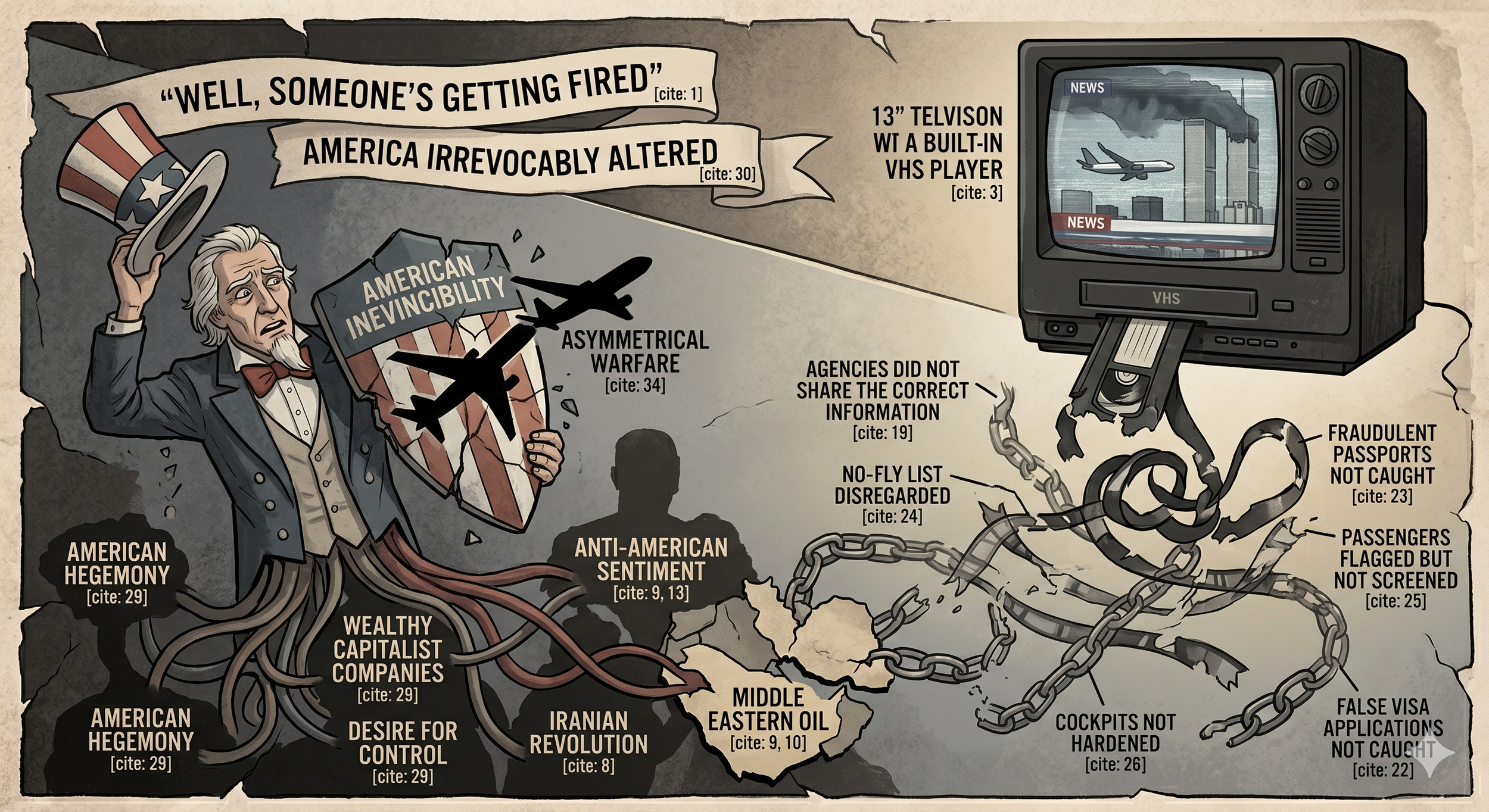
Image generated by Google Gemini using the prompt “Create an image based on this essay.”
The essay below is what I submitted as my final for Sociology: Deviant Behavior.
September 11, 2001, started as any other day had started for me for the previous few weeks: it was Tuesday, which meant I had college Algebra at 9:30 and no desire to show up to that class. I sat on the narrow dorm bed in the dorm room I shared with a guy named Josh and opened a packet of strawberry pop tarts to consume while watching the morning news and trying to overcome my executive dysfunction’s urgings to stay in. There, on the 13” TV I had brought to share – thick, black plastic and a built in VHS player at the bottom, right next to the red and yellow receptacles for the kind of video/audio cables that had become ubiquitous. There was a CNN anchor getting excited and talking about a passenger jet that had just crashed into the side of the World Trade Center in New York City. At eighteen, my first thought was, “Well someone’s getting fired.” Surely air traffic control or the pilot had made a major mistake. Then, before I finished my breakfast, a second plane repeated this feat, and it became clear that this was no accident. By the time the third plane slammed into the Pentagon, the highways at the edge of campus and the side streets were all empty. Classes were cancelled; people were advised to stay inside. Outside, I could hear people gathering in the common areas and worrying that we might be next, as the tallest building in Lexington. I hadn’t the heart to tell them that the difference between the World Trade Center and our dorm were significant. These were the first attacks on American soil since Pearl Harbor, and they transformed America.
After the attacks and staggering loss of American life, the country collectively experienced a form of Post Traumatic Stress Disorder. Numb at first, confused reports trickled in, rescue efforts were organized. By the time the last firefighters left the attack areas, America was galvanized to protect themselves. “Never again” and “Don’t let the terrorists win” rolled into messages of “see something, say something” and cold-war style requests to rat out that neighbor that looks the slightest bit suspicious or anyone that wore headgear that was just a wrap of cloth. All of this would occur of a clash of ideals and interventions in disparate parts of the world. Dr. Peter Hahn, professor of history at Ohio State University, tells us that the attacks had been building for “more than a decade” (Hahn, n.d.). In his article, Dr. Hahn explains that the causes were a confluence of the Iranian Revolution, the Soviet invasion of Afghanistan, and the assassination of the Egyptian president, as well as US backing of Israel, all culminating in heavy anti-American sentiment. It should be note that the Iranian Revolution was in response to the American-backed coup decades before to maintain access to Iranian oil. The Iranian Revolution, also known as the Islamic Revolution, would reverberate through the Islamic world and America’s continued interventions in pursuit of oil and power triggered the “basic canon of Arab life” as accounted by Leon Uris: “all of us against the infidel” (Uris, 1985, p.17).
From this, it’s easy to see why anti-American sentiment grew, but what does the Russian invasion of Afghanistan have to do with it? Osama bin Laden was Saudi national who saw the Gulf War as a violation of the sacred spaces in and around Mecca – the Islamic holiest of cities (Hahn, n.d.). He used the organizational network and unconventional tactics he had perfected in his contesting of the Soviet invasion against America, who was now seen as his enemy, beginning around 1996 (Hahn, n.d.). This group, known as Al-Qaida would be known to American authorities and the intelligence assets of both Presidents Clinton and Bush, along with various law enforcement and military operations, had been set to stop them, but ultimately failed to find out about the September 11th attacks in time to foil them.
Before there was even an official death toll from the attacks – nearly 3,000 people across all locations, including rescue workers – the country asked itself, “Could we have prevented this?” Numerous government agencies launched investigations into the policies and procedures to answer just that question. While my initial reaction to the terror attacks was that someone was going to be fired, this would not be the outcome. Some high-ranking officials did resign; others were shuffled around as the government was reorganized. Across multiple areas of the government, the US would conclude there were numerous small and large faults that let this happen. These include (National Commission on Terrorist Attacks Upon the United States, 2004):
Agencies did not share the correct information.
Agencies disregarded information from other agencies.
Some of the terrorists involved had previous reasons they should have been flagged on no-fly lists and were not, including one involved in an attack on the USS Cole.
False statements on visa applications were note caught.
Fraudulent passports were not caught.
The no-fly list did not automatically include individuals from the terrorism watchlist.
Airline passengers flagged for additional screening were not screened – including one terrorist – and only had their checked baggage held to ensure they did, indeed, board the flight.
Aircraft were not hardened to prevent cockpit breaches, allowing the attackers to take over the planes and use them as weapons.
Changes would occur across the government because of this, all with the idea that if certain changes in our prevention mechanisms were in place, we might have stopped this. We could have prevented it. Yet, what was not analyzed, or at least not publicly stated, was that the real prevention would have come from a change in US policies. American hegemony, influenced by wealthy capitalist companies, and a desire for control were the cause, and so a change to US policies would have been the true preventative.
Over two decades have passed since the September 11th attacks and, despite all the propaganda to not let the terrorists win, to keep the American lifestyle strong, I can only conclude that they did win. America was irrevocably altered and led down a path that took it away from the America I had known in my childhood. For eighteen years and one month, America was sold to us as a beacon for immigrants, a bastion of freedom, and the most impressive democracy in the world; twenty years later and the country is closing borders, being openly racist, and Islamophobia and divided neighbors have many concluding that the end of an empire is upon us. If this is, indeed, the end of an Empire, I cannot say it was because of 9/11, but the deadly use of those airplanes did more than bring down thousands of lives and a few buildings – they accelerated isolationist tendencies, power grabs that would span the world, and instilled paranoia that made conspiracy theories and disinformation more plausible. September 11th showed the world that America was not invincible and the same tactics that we were taught in school that led to the winning of the American Revolution would be used to bring us down as well – asymmetrical warfare. Or maybe the lesson is that the greed of powerful people and empires will lead the oppressed to fight back with the means at their disposal, no matter how unconventional or dishonorable they might be in the eyes of the oppressor. America must learn from these lessons if it is to recover its once-great spirit.
References
9/11: Causes and lingering consequences | The Ohio State University. (n.d.). Retrieved May 6, 2026, from https://www.osu.edu/impact/research-and-innovation/hahn-september-11
National Commission on Terrorist Attacks Upon the United States (2004). The 9/11 Commission report: Final report of the National Commission on Terrorist Attacks upon the United States. US Government Printing Office. https://www.govinfo.gov/content/pkg/GPO-911REPORT/pdf/GPO-911REPORT.pdf
Uris, L. (with Internet Archive). (1985). The haj. Boston, Mass. : G.K. Hall. http://archive.org/details/haj0000uris