Dear America, Do You Still Dream?
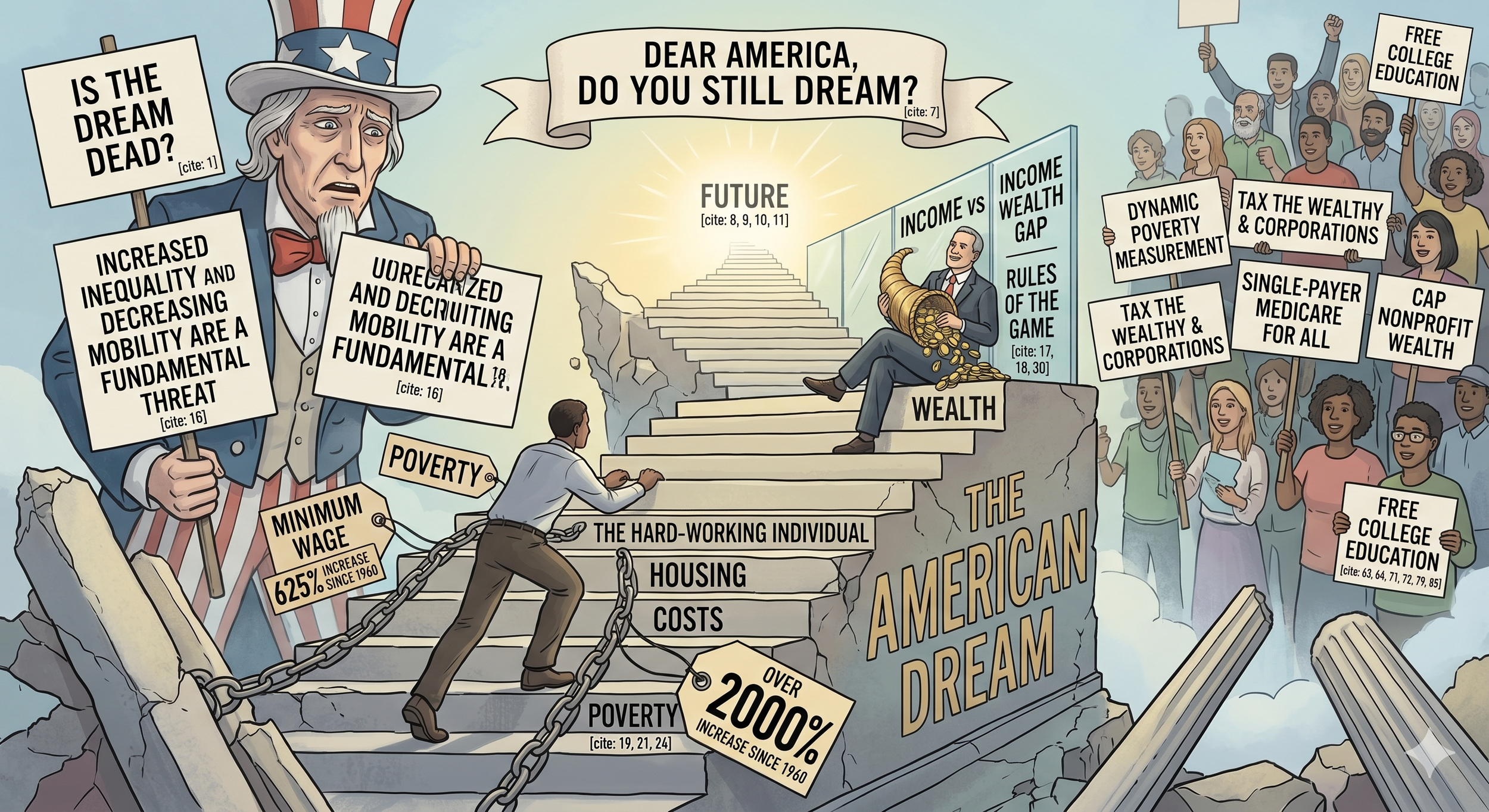
Image generated by Google Gemini using the command “Generate an image based on the attached essay.”
In 1931, historian James Truslow Adams defined the American Dream as “a dream of social order in which each man and each woman shall be able to attain to the fullest stature of which they are innately capable, and be recognized by others for what they are, regardless of the fortuitous circumstances of birth or position” (Adams, 1931, p. 214-215). The American Dream has always been a dream about equality. Whether one’s personal interpretation about the Dream is one of consumerism – if you work hard, you can buy all the things you want – or a more democratic and universal sense of brotherhood, the Dream was one where no matter what your origins, you could do better for yourself. Yet, if one were to search the Internet for the American Dream, the top results – for several pages! – would be lamentations about the death of the American Dream. Watch the videos, read the essays or opinion pieces, and the prevailing theme is this: The American Dream has been brutally tortured with repeated shallow cuts and the prognosis is terminal. This is not just a modern view of the Dream, but a repeated pattern first expressed by Adams himself when arguing that the Dream had become one of buying things instead of the grand equality promised by our founding documents. How did we, the self-proclaimed greatest nation on earth, go from the lofty ideals of “all men are created equal” and hold an inalienable right to “Life, Liberty and the pursuit of Happiness” to poking the corpse of Uncle Sam lying in the ditch (Continental Congress, 1776)?
Before unraveling why former President Barak Obama said “the combined trends of increased inequality and decreasing mobility pose a fundamental threat to the American Dream” one must understand the terms used in this discussion (John Oliver, 2014, 0:30). Income refers to payments made on a regular basis, usually for work performed or interest accumulated, over a period – like the yearly incomes this paper will speak on. Wealth is the monetary value that has accumulated to date after removing what is necessary to balance negative amounts – e.g., wealth is accumulated income. As calculated by the United States, poverty is measured by the government as less than $12,880 for an individual or $26,500 for a family of four. This threshold is set by the US government and is reported to include 35.9 million people in 2024, or about 10.6 percent of the US population (US Census Bureau, 2025).
In the United States, poverty is calculated based on formula created in 1960 by an economist at the Social Security Administration and is based on the cost of a minimum food threshold multiplied by three (Census Bureau, 2026). At the time of its creation, food was a large portion of calculation, but in the 8 decades that have passed, the cost of housing has risen more than 2000% (FRED, 2026) and the cost of healthcare has gone up over 19000% (CMS, 2026). Meanwhile, USDA data shows that the percentage of a household’s income spent on food has dropped from 17.5% in 1960 to 11.2% in 2023 – though, it is important to remember, that prices have increased overall, this just shows that other prices have risen in greater proportion (BLS, 2025). During this same window, the federal minimum wage has increased, but only 625%, a raise so small it does not cover a single category’s increase (DOL, 2026).
Sociological View
Theories and Perspectives
There are many theories and perspectives on poverty. Theories grouped under the banner of conflict theory point out insights about who benefits from the existence of poverty, while functionalists point out that poverty serves a function of encouragement to get people to improve their lives. While these theories explain the what or the why, they do not offer the same possibility of amelioration of the problem. For this, Chrstopher Jencks, based on his Harvard research, offers a clearer path forward. Jencks pointed out that the large gap in American inequality, between the wealthy and the poor, is a function of the rules of the game of capitalism as we play it (Gilbert, 2020, p. 138). In Jencks’ view, the solution to poverty is to reduce the rewards and costs of failure when it comes, providing less incentive to squeeze every dollar out of everything.
Pros and Cons
For those who live in poverty, there is very little upside to be found. Scant comfort is offered through a functionalist perspective, which would tell us that poverty serves the function of demarcating a society’s socio-economic hierarchy, or that it provides an indicator of failed institutions. Rather, when looking at pros vs cons of the inequality represented in poverty, what is found is largely cons. Poverty erodes social cohesion with the greater society while encouraging closer social bonds among those who experience the condition, which can lead to increased deviance and upset to the established social order. Economically, poverty shows that wealth is being hoarded elsewhere and creates a class of people unable to fully participate in their society and may even lead to a class of people unable to support an economy as those most often making smaller but very regular purchases (the lower classes) are removed from that aspect of a society.
Ethical Considerations
Inequality, and specifically poverty, present a challenge for several moral and ethical standpoints. Dr. Taro Komatsu directs attention to the role that extreme inequality plays in eroding social cohesion, calling it “alarming” and capable of preventing trust between strangers on a basic level, which is required for the functioning of any society (Komatsu, 2015). Utilitarianism, a branch of ethics that obligates decisions to be made that maximize the most benefit for the most people, gives a “radical” mandate to people to eradicate poverty, as sharing the wealth among money provides more good than to hoard it among the few, according to Professor Brian Berkey of the Wharton School of Business (Berkey, 2023, p. 4).
Solutions and Conclusion
Political and Economic Solutions
Social problems are social constructs - issues put forth by someone in a society with such persuasion that the problem is, indeed, detrimental to the whole of society enough that others join the cause. As such, social problems often face the hurdle of not being bipartisan; what one side of the American political spectrum says is a bug, the other side claims is a feature. If President Obama stands in for the political left, then President Donald Trump speaks for the political right when he declared “the American Dream is dead” and that he would cause prices to “come down substantially” and “achieve incredible economic growth” (WCYB5, 2024). With both sides of the aisle showing strong indication that they view poverty as a threat to America, that the American Dream is a dream worth having, then why have we not made greater progress on fighting poverty? Agreeing something is a problem is one thing but agreeing on the cause and the solution provide an infinite amount of press coverage for those whose livelihoods rely on the attention and anger of others.
Neoliberal policies, as promoted by the Republicans and Libertarians, continue to push the narrative that has been coined “trickle-down economics” or “Reagonomics,” a philosophy that taking care of the people on top of the economy will trickle down and help those on the bottom. This position is strongly entrenched in traditional economic models from a pre-Internet world and in what Max Weber referred to the Protestant Work Ethic. Regan, himself, oversaw a rise in poverty under his administration. While Nixon saw a decrease in poverty during his administration, this was largely due to the infrastructure provided by the War on Poverty established under his predecessor, Johnson. The policies of the Democrats have been more favorable to decreasing poverty. Beginning with the establishment of Social Security and Food Stamps in the late 1960s under Lyndon B. Johnson, Johnson, Clinton, Obama, and Biden have all overseen substantial (greater than 4%) decreases in poverty during their administrations (Census, 2024; Poverty Center, 2026). This was largely achieved through expanding existing social safety net programs or adding new ones. Then there is the growing leftist population who see a world where politics should never interfere with the basic principles of life and that economically, America is wealthy enough in money, resources, and technology that a new way forward is possible.
My proposal
Fixing the American Dream is a multi-part process that includes lifestyle changes. Since poverty is defined by how well an individual can access food, shelter, and medical care, there are two areas that can be used to reduce overall poverty: increase wages to make services more affordable or reduce the cost of the services. This latter can be done through direct cuts to prices, but also by providing tax incentives that offset some of the cost. While working on the poverty problem through any single method is still worth doing, the true path to eliminating poverty as a barrier to the American Dream is by tackling the problem from all angles.
First, we need to create an official measurement of poverty that is updated regularly and is dynamic, rather than fixed and unchanging for decades. At a minimum, this metric should be updated at each decennial census, but preferably every 5 years. This allows for adjustments due to inflation to reflect while people need the assistance and without waiting for new laws to be passed with new benchmarks that use net income. This same update schedule should be automatically adjusted for statutory minimum wages as well, ensuring that the minimum wage remains the livable was intended to be and keeps pace with inflation (Roosevelt, 1933). These measures should be confined to similar geographic regions, as even conditions inside a state can vary; consider using voting districts. Likewise, pay in all three branches of government – Legislative, Executive, and Judicial – should be tied to the minimum wage, whether the position is elected, appointed, or hired. As a percentage of the minimum wage, capping pay scales across the government ensures a significant number of people who are invested in keeping the minimum wage current.
Change the tax codes: tax the wealthy, tax corporations. The tax rates on both large-earning groups needs to be increased significantly, providing necessary funding for other improvements. These tax changes should include mandatory minimums for any earner – person or corporation – who earns over a certain amount – say a guaranteed minimum for anyone over $100M. There should also be a cap on how much wealth nonprofits can accumulate – including churches – and anything over that cap should be taxed. Tax penalties should be implemented for any organization of medium or larger size that has a pre-determined percentage of their workforce that qualifies for social welfare benefits (qualifies for, not necessarily on); this will encourage employers to pay fair wages. Similar penalties should be added for too wide a gap between C-Suite pay and the median employee pay, encouraging employers to increase all pay with efficiency and not just top-level management. As the purpose of the taxes is ensure social viability, everyone must pay. This will mean removing the exclusions to income over $150,000 being taxed for social security; the plan works when everyone pays, and no one can say for sure that they will never need the program. Likewise, a high tax on any homes beyond the first, and a ban of private companies owning single-family homes or too many apartments, should be implemented to drive down prices of real estate and make housing more affordable.
Next, with the additional tax revenue, America should implement a single-payer tax plan – something like the “Medicare for all” movement. This health coverage should cover every citizen and national of the country, regardless of their income level, and automatically be granted to every social security number. The Medicare agency shall be empowered to negotiate directly with suppliers, ensuring a proper use of collective bargaining to lower prices. While private insurers should still be allowed, and still made available to the general citizen, everyone who is paid by the Federal Treasury must use only Medicare, further incentivizing legislators, executive officers, and the judicial branch to keep this program working at its best. Medication and procedures flagged as necessary for life (insulin, asthma medication, blood pressure and cholesterol medication, anti-depressants, etc.) will never have an out-of-pocket cost to the citizen, and transportation to an emergency department should be covered. Mental health and dental health must also be covered. These measures will ensure that medical expenses do not drive people into, or keep them in, poverty while also increasing both the average lifespan and the average age of retirement as people will be in better health and can work longer.
With the correlation between educational attainment so high when contrasted to earnings, it would also behoove the USA to provide free education through, at least, a bachelor’s degree or equivalent trades level certification. Removing cost as a barrier to entry ensures that we truly have America’s best and brightest ready for the challenges of the future, and not just the best and brightest of the wealthy subclass.
Conclusion
Poverty is one of the defining social problems of not just one generation, but many, stretching back into mists of prehistory and forward as far as our eyes can see today. That is, unless we do something to change it. In an era of society known for its echo chambers and extremism, the country must first be capable of holding the same conversation about poverty – agreeing to terms we use, the concepts we find important, and how frequently we will update our understanding. More than that, we must agree to the border between personal responsibility and what is impacted by aspects of society for which the individual should not be held accountable. Addressing the inequality of poverty in America will not be easy, nor quick, but the American Dream was always about putting in the work and reaping the rewards. As a people raised with this dream and the idea we have to work hard to play hard, why should we not put in the effort?
References
Affairs, B. C. for R., Peace and World. (n.d.). Poverty and Inequality: Our Ethical Challenges. Retrieved May 3, 2026, from https://berkleycenter.georgetown.edu/responses/poverty-and-inequality-our-ethical-challenges
Berkey, B. (n.d.). Utilitarianism and Poverty.
Bureau, U. C. (n.d.-a). Historical Poverty Tables: People and Families - 1959 to 2024. Census.Gov. Retrieved May 2, 2026, from https://www.census.gov/data/tables/time-series/demo/income-poverty/historical-poverty-people.html
Bureau, U. C. (n.d.-b). How the Census Bureau Measures Poverty. Census.Gov. Retrieved April 27, 2026, from https://www.census.gov/topics/income-poverty/poverty/guidance/poverty-measures.html
Bureau, U. C. (n.d.-c). Poverty in the United States: 2024. Census.Gov. Retrieved April 27, 2026, from https://www.census.gov/library/publications/2025/demo/p60-287.html
Bureau, U. C. (n.d.-d). The History of the Official Poverty Measure. Census.Gov. Retrieved April 27, 2026, from https://www.census.gov/topics/income-poverty/poverty/about/history-of-the-poverty-measure.html
Consumer Expenditures—2024—2024 A01 Results. (n.d.). Retrieved May 2, 2026, from https://www.bls.gov/news.release/cesan.nr0.htm?utm_source=copilot.com
Gilbert, D. L. (2020). The American class structure in an age of growing inequality. Sage Publications.
Historical | CMS. (n.d.). Retrieved May 2, 2026, from https://www.cms.gov/data-research/statistics-trends-and-reports/national-health-expenditure-data/historical
Historical Supplemental Poverty Measure Data | Center on Poverty and Social Policy. (n.d.). Retrieved May 2, 2026, from https://povertycenter.columbia.edu/historical-spm-data
History of Federal Minimum Wage Rates Under the Fair Labor Standards Act, 1938—2009 | U.S. Department of Labor. (n.d.). Retrieved May 2, 2026, from https://www.dol.gov/agencies/whd/minimum-wage/history/chart
Last Week Tonight with John Oliver. (2014, July 14). Wealth Gap. YouTube. https://www.youtube.com/watch?v=LfgSEwjAeno
Median Sales Price of Houses Sold for the United States (MSPUS) | FRED | St. Louis Fed. (n.d.). Retrieved May 2, 2026, from https://fred.stlouisfed.org/series/MSPUS
Roosevelt, F. D. (1933, June 16). Franklin D. Roosevelt Presidential Library and Museum—Our Documents. FDR Library. Franklin Roosevelt’s Statement on the National Industrial Recovery Act. http://docs.fdrlibrary.marist.edu/odnirast.html
Sernau, S. R. (2023). Social inequality in a global age. Sage Publications.
Trump declares “The American Dream is Dead.” (n.d.). [Video recording]. Retrieved April 27, 2026, from https://www.youtube.com/shorts/IPB1J4iN_gY